Saturday, 11 October 2014

Stop calling me a "squealing pig" - community rallies against paid parking

There's a good thing that happens when governments and councils do things the communities they represent don't like - the community bonds and you meet your neighbours.

We don't need #nopaidparking.
© 2014 divacultura
This morning Melbourne's inner west villages of Yarraville and Seddon rallied and marched against plans by the Maribyrnong Council to introduce paid parking. On my way to the village, I joined with Caroline and her dog Kaiser and we chatted and walked together to the rally point. At the rally I spied Erin from my dance class and we walked together with Dave and Holden the dog (he has the world's softest ears). We talked about our community - the place where we live - and discovered we share many views.


Melbourne presented us with perfect rally weather - around 20 degrees Celsius, slightly cloudy with a light breeze - and I was told by one of the local councillors that 400 people had been counted in the march from Yarraville to Seddon.

The council claims that paid parking will increase turn over and therefore provide more parking. There are currently time restrictions on parking but I don't see them being well enforced.  I've seen no evidence that supports the idea that paid parking will improve turn over. It may free up parking as people choose to go down the road and shop at the Coles supermarket or Highpoint Shopping Centre where parking is free and plentiful.

Unhappy rate payers.
© 2014 divacultura
I've lived in Yarraville since 2007 and love the village feel. I often tell people that it's like living in a country town with all the convenience of being in a big city.  I generally walk to the village, but on occasion I'm in my car - usually when I'm on my way to or from somewhere else. I drove over on Thursday because I had a wine delivery to collect from the post office. I parked for 5 minutes and was gone. It would take me twice as long to find coins and walk to the machine, pay and put the ticket back in my car if I had to pay.


Retailers are naturally concerned that forcing people to pay to park will drive their customers away. A community-led study has been conducted and shows they have reason to be concerned.

It was great to see two of the local Councillors representing the Yarraville ward at the rally. Martin Zakharov and Michael Clarke were vocal in their concern, while clarifying that the law prevents them from stating which way they will vote when the proposal is brought to Council. Armed with the mobile numbers of all Councillors I contacted each of them by text message. Councillors Zakharov and Clarke received a thank you to acknowledge their presence. Each of the others received this message (including my full name):

"I'm disappointed that you're not here to talk to Yarraville and Seddon community about why you think paid parking in our villages is a good idea. Where are you?"

So far, one councillor, Sarah Carter has responded. She had just landed from an overseas flight. I will follow up with an email.

Hear! Hear!
© 2014 divacultura
There's one aspect of the community organising that I don't understand. Councillor Catherine Cummings has been quoted and reported to have commented about local residents "squealing like pigs". The parking study revealed a highly educated population, so why we would be asked to buy into this and squeal like pigs at the rally is beyond me. I'm not a squealing pig; I'm a concerned resident who is engaged with my community and has heard no good reasons for the introduction of paid parking. I'm worried about the damage this will do. This does not make me, or any of us, squealing pigs.

Walking back home after the march, I discovered a new shop and ran into Councillor Zakharov (you can see him on saxophone in the first photo above). We walked together for a while and talked about the events of the morning. It was great to have the opportunity to acknowledge him in person.

Council meets this Tuesday. We need to continue to be visible and vocal.

UPDATE:

I received a response to my text message from Councillor Cummings after publication of this post. She tells me that she decided not speak so Councillors from the Yarraville ward could speak. She writes that she was there to listen and help her decision making process.

Don't know how she could vote "yes" then!


Thursday, 9 October 2014

How to avoid feedback disasters - what's your purpose?

Giving, receiving, thinking about and teaching feedback occupies a large proportion of my time, both at work and in my private life. I notice how people avoid it, crave it, botch it and do well and wonder at the variability of attitudes and capacity. Part of  my vision for an improved world is doing it better and appreciating the value of feedback.

So I was pleased to recently work with a medical college in trial exams for candidates to practise and receive feedback about all aspects of their performance: medical knowledge, exam technique, communication with me, the simulated patient, and their overall competence.

My case was intense, requiring me to cry and be angry about the situation. As an acting job, it was excellent. I had a really lovely doctor to work with as he conducted the trial exam station.

Candidate after candidate struggled with both the medical knowledge and their capacity to communicate. They often freak out when confronted with a simulated patient who is crying and angry just like a real patient would be in the same situation. Usually they recover. I quickly discovered that the doctor with me had a very different view of good communication. I also learned that many candidates were having significant problems with the medical aspects of the case.

After all candidates had had their trial, we saw them again for two minutes of feedback. After hearing from the doctor how terrible everyone was, I was surprised to hear him start by telling people "you did well". He'd then list - in exhaustive detail - all the areas of failure. He sent them off by saying they "weren't too bad" or "but you did ok".

I was confused. The candidates looked confused. They really wanted to know about their performance. They were participating in this trial exam so that they knew where they had performed well and what they needed to improve. Instead they received a confusing message that left them with no information about what they should do next time. The next time would be when they sit the actual exam.

I took the opportunity to observe and think about what was going wrong and how I would coach the doctor on providing useful, effective feedback.

The first question I would ask would be "what's the purpose of the feedback you're about to deliver?" Then to further clarify, "what do you want to happen as a result of this person receiving your feedback?"

Answering these questions before any feedback conversation will help remove our sometimes overwhelming desire to be liked from the feedback conversation. Interestingly, if your purpose is clear and about helping the other person, they probably will like you because you've taken the time to give them effective feedback that will help them do better in their world.

Listening to the doctor deliver his confusing messages, I tried to discern his purpose; it seemed it was about fulfilling part of the process of the trial exam. Where's the value in that? Feedback is part of the process and there's no doubt there was an obligation on him to provide it, but if the purpose of feedback is merely procedural then no one will benefit. It will be hard to deliver and unhelpful to receive. At its worst, it may also have a negative impact on the relationship between people.

Consistently I find that a lack of clarity around purpose is where people stumble. And it's not just in feedback conversations. Any conversation can benefit from clarity of purpose. Where the conversation is a strategic one (rather than a casual one), it needs to be planned. If you do nothing else, be clear about the answers to these key questions:

1.  what's the purpose of the feedback you're about to deliver?

2. what do you want to happen as a result of this person receiving your feedback?

It can change your life!


Wednesday, 8 October 2014

Mental Health Awareness - it's up to all of us

It's World Mental Health Week and it's great to see and hear so much happening to educate us about mental health.

This week I'm at the College of Mental Health Nurses Conference in Melbourne talking to people about the mental health clinical education toolkit that I've produced for St John of God Health Care. It's giving me the opportunity to meet nurses who are working in all kinds of places but all share one thing - a commitment to quality care for people who have mental health problems. I've met nurses working in hospitals; nurses working in Medicare Locals; community nurses working in cities and regional areas; nurses working in prisons, other forensic settings and assessing asylum seekers . There are also educators from hospitals, other health care providers and universities.

ABC has programmed lots of interesting things under the banner of "Mental As". What a fantastic contribution to the education of our community. I think some of what I've seen can really make a difference to creating supporting understanding and empathy in the community. Monday night's Q & A on television had a panel of people talking frankly about mental health in rural and regional areas. The panel included a psychiatrist, a comedian, a lived experience practitioner (something I've just learned about), a politician and a CEO from a community organisation and the quality of the questions and conversation showed just how much we're thinking about mental health and experiencing in our daily lives. (You can catch up on the show, read a transcript, see the questions posed and learn about the panellists on the website.) It was stimulating television: I was challenged. I was moved. I was educated. I was frustrated. I was angry. I was relieved.

Last night - again on the ABC - the first episode of Changing Minds aired. It takes us inside the psychiatric unit at Sydney's Liverpool Hospital. I regularly visit private mental health hospitals, but am not exposed to the clinical interactions. I see patients walking around and always greet and acknowledge them. I know that my experience is more than most lay people would have, but going inside a public ward where people are sometimes there under the Mental Health Act was a new experience.

The focus last night was on three people who have bipolar disorder and were in various stages of treatment for manic episodes. We saw Patrick towards the end of his stay and then back at home. We met Glen who is up and down. We met Sandra who is at the beginning of her admission showing nasty irritability and disordered thinking. I struggled with my own reactions to these people and admired the good humour and empathy displayed by the staff. Sandra was very suspicious about the medication a nurse was dispensing, initially denying they were correct. She insisted the nurse go through each tablet, explain what it was and then put it in a particular place. I was rolling my eyes from a distance and was so impressed to watch the nurse who patiently and respectfully responded to Sandra's needs.

What I've noticed is that all this conversation really does work against stigma. I believe this is the first step necessary for healing and understanding in our world.

Last night's program has also helped discovery within my own family. One of my family members has bipolar disorder and each of us has our own experience and attitudes as a result of living with this person. I've been open about this in my close circle, but have not talked in the wider world. The raising of mental health awareness has helped me understand that there's value in sharing my experience and insight with others. I have several close friends who also suffer with depression and anxiety. I know from talking to them that understanding isn't always there.

What's your experience of mental health? How are you engaging in the conversation? What can you learn to help understanding of people who have mental health problems?

If you're at the conference why not drop by the Australia Catholic University stand and say hello?


Monday, 29 September 2014

It's all about the conversation

What is it about car trips that enable good conversation?

Today's conversation was as much about the relationship with the person as it was about being in a car; we have excellent conversations where ever we are.

Last week's conversation was revealing for both parties. Is it the lack of eye contact?

I've also written whole songs while driving alone. Thank goodness for recording apps on my iPhone! I've heard tell that driving engages the left brain. While the left brain is busy, the right brain is free to play. I've certainly found this to be true.

I like being the passenger when I'm confident in the driver. Today I was so relaxed I took out my knitting. I was on a knitting deadline and needed to finish the second sock of a pair by the end of tomorrow. It was the car trip or it was never going to happen. At one moment my mind wandered and I had a flash of death by knitting needles if there was an accident.  Was this the catastrophic thinking about which mental health professionals speak? I choose to think it was a little flight of fancy taken by my right brain.

Back to conversation in cars...I recall many occasions when I've bonded with someone or made deep discoveries or found myself on a journey of revelation when on a road trip.

In my world we could abolish interrogation techniques and instead embark on a road trip with a high value prisoner.  All would soon be revealed without the need for inhumane actions (unless you count the carbon output).

Is there a PhD in this? Alternative questioning techniques? I worry that the world isn't ready after discovering all the bins at Flinders Street Station have been removed because of "security". We'd better brace ourselves for the trains to become even more of a garbage tip.

The conversation isn't as good on the trains. Maybe it's the impact of being observed.

I'll continue that conversation over dinner in Wangaratta.


Sunday, 28 September 2014

This uncertain world

The world feels so unsure right now.
On television, politicians defend laws that deprive us of liberty in the name of terrorism.
On television, the same politicians ignore the global threat that climate change poses to the whole world.
On television, the suffering caused by Ebola in Africa seems distant and apart from us.
On television, we are reassured that the Royal Melbourne Hospital is trained and ready for Ebola.
Going through security for domestic flights, the security seems no more onerous than usual; sometimes they wish to unfurl my umbrella.
Most of the time they are happy to leave it furled in the bottom of my bag.
They are polite.
Except for the man at a small regional airport who said he would need to rearrange my bag because it was a "complete mess".
I looked at him and blinked, not daring, where the air is tense with unrealised threat, to tell him to pull his head in.
Until recently this airport had no security; one just walked across the tarmac to board the waiting plane.
I wanted to go home, not to a white room with a chair, a table, greying linoleum, no windows and no lawyer.
The radio broadcasts reports of attacks, arrests and mysterious packages.
I am transported back to that place where mysterious packages and powders were easily spied.
I arrive home to discover the front security gate has been torn from its hinges.
What uprising took place while I was gone?
Walking around the neighbourhood while the AFL grand final is being played across town at the Melbourne Cricket Ground, the streets were deserted.
I crossed the road easily, for there were no cars.
Periodically, synchronised roars would arise from separate houses, punctuating the play.
I hope the crowd is safe, not vulnerable.

I'm rereading "Slaughterhouse-Five" by Kurt Vonnegut. In chapter four, Billy Pilgrim is in a train car, being held prisoner by the German army:

"When food came in, the human beings were quiet and trusting and beautiful. They shared."

If only life was like that.
Calm sanctuary in a mad world.
© 2014 divacultura
During the week I visited one of the psychiatric hospitals for which I work. The gardens are beautiful and I've already decided to book in if I should fall apart. This was my view as I ate my lunch.


Monday, 22 September 2014

Auction-packed weekend continues - menswear for sale.

It was an auction packed weekend. After visiting the cattle sales in Tamworth on Friday, I went to a clearing sale for a local menswear store, Blowes. A bit over a year ago, the local newspaper reported that the company had gone into voluntary administration. Now it was time for the clearing sale.

The process was much the same as the cattle sale, except that any price seemed to be acceptable and the range of items being sold was extensive.  Everything from packs of shirts, underpants, hats and shoes to cash registers, shop cabinets and a range of mannequins was available to be had.  Buyers registered and were given a number to keep track of who had bought what. One experienced sale-goer had tucked his number into his hat band. "Number 30" was visible where ever he went. While I was there, I didn't notice him buy anything, but he certainly looked like a rival for whatever took your fancy.

The dry humour of the auctioneer made the experience an entertainment, even if you weren't in the market for menswear or shop fittings.

"Lot 27 - a straw hat, size very small - for a very small head...no good for you sir! Do I hear $20?"

A man called Marty got a hard time whenever small sized shirts were being sold: "You'll have to pass that one up Marty!"

"Next lot - 10 green ties." The auctioneer paused as he searched for the sales pitch. "Good for a team! How about a fancy dress party? Do I hear $20?"

"Next lot - 10 blue ties!" He shook his head and just asked for a bid.

"Next lot - 10 pairs of briefs! (What size are they?) Assorted sizes! (pause) Outfit the whole family!" I heard him chuckle under his breath that it was the first time he'd auctioned underpants.

Bargains were being snapped up. Everything was being sold. Occasionally the bidding went down and someone would snare a bargain; other times it was a fierce and exciting contest. Eye contact with the auctioneer and his assistant was everything. The more experienced buyers could be detected by the subtlety of their bidding - the merest suggestion of a head movement and the bid was theirs. The greener waved their numbers in the air and they had the bid. I was standing amongst a group of seasoned bidders and was terrified of buying something I didn't want and couldn't transport back to Melbourne. Knowing my luck, an itchy nose would result in the purchase of  23 boxes of wooden coathangers ( a bargain at $5); a stray hair would lead to being saddled with a collection of unidentifiable "sundry goods" (daylight robbery at $5), a passing fly and I'd be the proud owner of 5 pairs of cufflinks!

I noticed a few people buying the packs of assorted sizes and lots of things like "10 black wallets" and wondered if they had their own store. Perhaps they were stocking up for Christmas. Others were trying on hats and boots and sizing up shirts, clearly stocking up their own wardrobe.

We left after about an hour and while it seemed that a mountain of goods had been sold, it was only a tiny proportion of everything that was on offer. I would have been happy to buy the three drawer filing cabinet that I spied at the back of the shop, but the logistics of excess baggage on a flight back to Melbourne were too much to contemplate.

All eyes on a bargain at Blowes.
© 2014 divacultura


Friday, 19 September 2014

The sights, sounds and smells of a cattle sale

On approach to the Tamworth Regional Livestock Exchange, two things struck me: the noise and the smell. Perhaps the volume is similar to the other kind of stock exchange but the sounds and the smells are probably quite different. Here the smell is the earthy smell of animal sweat, manure and dirt.

Anyone got a spare hat?
Copyright 2014 divacultura
Going to a cattle sale was a new experience and I was pleased to have the opportunity. It immediately proved a good decision that I had swapped my new silver casual shoes for a pair of my brother's boots. They were a size too big but I would have been even more obviously alien in the crowd in my ridiculously urban shoes. With my hair in a pony tail, a cap on my head and clad in a pair of jeans, I was receiving some enquiring looks. I certainly looked nothing like the rest of the people there. For one, they were male. I'm not. I was wearing the wrong kind of hat. My eyes didn't have the right appraising glint as I surveyed the pens of cattle.

I was careful not to fall into a pen; it was a special female sale today and I didn't want to find out how much I would fetch.

Auctioneers busy at their work.
Copyright 2014 divacultura
The cattle are contained in rows and rows of pens with concreted alley ways in between for the buyers, sellers, agents and other people. Tags of various colours tell the story of how old they are or whether the cows might be in calf. The auctioneers walk on a gangway elevated above the pens. They stop at each pen and say a bit about the animals in the pen that's about to be sold. The auctioneer is flanked by several men in big hats who identify the bidders in the crowd. A woman is nearby carrying a big stick that she holds over the pen being auctioned. I learned that this is a scanner which takes the details of the national livestock identification tags in the ears of the cattle. This enables each animal to be traced from its birth and is important for ensuring the safety of meat.

There are several auctioneers. They wear the uniform of jeans, pale blue collared shirt and very big, light coloured hat. They are amplified by a Madonna-style microphone and portable speaker which they either wear on their belt or is carried by another person. Some of them aren't amplified at all. They talk quickly as they explain what's for sale and then they accelerate as they search for the first bid. Their diaphragms work hard to ensure they have enough breath. Eyes are watchful, ears pricked and somehow, above all the noise of the people and the livestock, purchase after purchase is made and the crowd moves to the next pen. It's exciting to see all these people at their work.

Just looking at the crowd, it's hard to see who might be a buyer looking for the lowest price they can get and who might be a seller hoping their animals will sell for enough to make some money, or at least, not make a loss. I think I see a glimpse of disappointment in the eyes of one rural man.

As I'm standing with my brother, asking all my questions so I can understand what's happening, a woman comes over and asks if she can take our photograph. She's doing publicity for the sales and we will feature in the sale highlights. I didn't expect to make the social pages of the local cattle sale, but there's a first time for everything. My brother is pleased because it will further raise his profile as a local veterinarian.

As we leave, the noise and smells recede. I look at my dusty feet, pleased that I'm not in my silver shoes. We go to the Sushi Train for lunch and I feel as if I've returned to more familiar territory. As I eat some beef, I wonder where it came from.

Here's what it sounds like:


Awaiting their fate
Copyright 2014 divacultura


Through the rails
Copyright 2014 divacultura


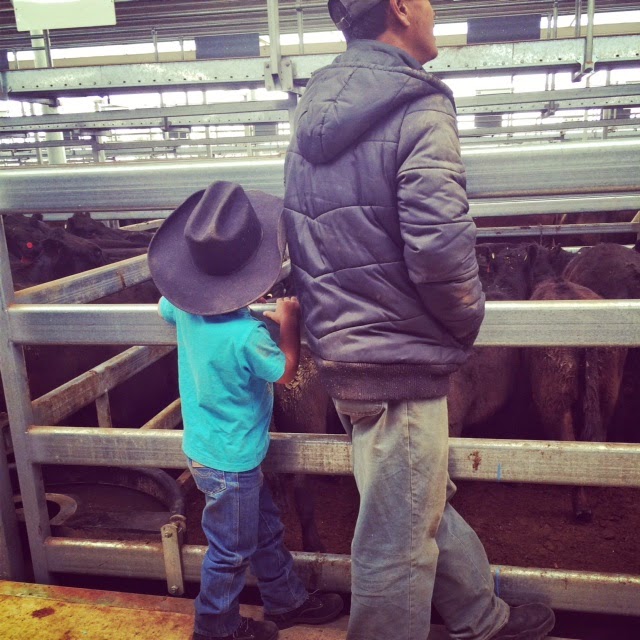
More hat than kid.
Copyright 2014 divacultura


Sunday, 24 August 2014

Sunday Slide Show


My vocal group rehearses in the hall attached to a Russian church.
While one of the other parts was rehearsing, I noticed the shadows thrown by the chandeliers.
© 2014 divacultura

Ghostly shadow.
© 2014 divacultura

From my "view from the office" series.
This is in the old part of the Royal Melbourne Hospital's Royal Park Campus.
© 2014 divacultura


Southgate sculpture.
I took this at about 6pm while I was waiting for my dinner date.
© 2014 divacultura

Taken the same night from Southgate looking across the Yarra River to Melbourne's CBD.
© 2014 divacultura
Early spring afternoon - Swanston Street, Melbourne
© 2014 divacultura


How was your week? Are you on Instagram? Why not pop over and say hello - I'd love to see your pictures.

Thursday, 21 August 2014

The thronging crowd - a test of mettle

If you've ever been at Flinders Street Station during the evening peak then you know the experience of being in a crowd where people are so focused on their own objective that they lose - or disregard - the people around them.

A growing crowd of eager commuters stands at the traffic lights, waiting to cross the road and enter the Station. The green man appears on the lights and we surge forward. Like the release of a dam gate, we flow in the one direction until we hit the next barrier - the turnstiles we need to navigate to enter the station. There is a narrowing of focus. This is where the jostling starts. People suddenly change direction; they cut off another's trajectory. Their heads are down, their eyes trained straight ahead. We're through the turnstiles and then there are some stairs (about 10?) to negotiate. The arrivals and departures board is right above these stairs. People stop suddenly to look up and confirm the platform from which their train is leaving. People suddenly change direction to get around the people who have turned to pillars of stone. Down the stairs and we're in an even narrower space. Most people are going into the station and so have swelled to take up the whole space. Pity the people moving against this tide. They resort to bags and elbows. Some try to keep left, but then find themselves trapped behind a SMP (slow moving person). They change direction suddenly to cut in front, usually without regard to anyone who might be behind or beside them.

I run this gauntlet regularly. I try to remain aware of those around me, but find myself becoming more bullish as I'm whacked by urban weaponry - backpacks, shopping bags, umbrellas swinging wildly, even jauntily.

Today was particularly challenging even before I reached the station. It made me think about a drama warm up exercise which is about building physical awareness of the space and the people within it. Everyone moves slowly at first in any direction, dodging and weaving through the throng. The speed builds. People rarely collide. I believe it is because participants in such an exercise are absolutely present and acutely aware of their bodies in relation to others. I've done this in a group where half the group is blindfolded. Again, people rarely, collide.

Thinking about this today, I wondered about how this kind of awareness in everyday life and activities could improve crowd behaviour, making everything easier and happier. I was reminded about my first visit to India a few years ago. I visited the southern city of Chennai. My hotel was on the opposite side of the road to the location of the nearest bank. I needed to get cash and thought nothing of stepping out to engage in the ordinary activity of visiting an ATM.

On stepping out of the hotel's calm, I was immediately confronted with the practical problem of how to cross the road. The voluminous traffic never stopped. There were no designated crossings or traffic lights. Observing the traffic - reading it as a surfer might read the surf - the chaos soon revealed an order of cooperation and awareness. Vehicle horns were tooted, but the sound was a happy beep that said "Just letting you know I'm over here".

As I stood marooned on the wrong side of the road, I watched some locals cross the road. I was horrified when I saw them launch from the safety of the kerb. As they made their way across the road, the traffic happily moved around them. It was like throwing a pebble in a pond. I was astonished to see them arrive safely on the other side. I took a deep breath but my courage failed me. I waited for some more people to come along so I could follow in their wake. They did and I did. It resulted in terrified exhilaration. I suppose that living with so many people teaches you awareness.

If I applied the same principles to the evening rush at Flinders Street Station, I fear you would find my body, trampled and bruised at the end of the rush. Generally Melburnians are great to be in a crowd with. My theory is that practice makes the difference: attendance at AFL football games in huge crowds from an early age teaches people how to get from A to B when B isn't even visible and there are 10,000 people in the way. The personal electronic device is one of the problems. Headphones are plugged in. Heads are down, rather than being up and engaged with the world.

All of this thinking leaves me pondering a further question - will we evolve to have another set of eyes in the top of our heads so we can look at the device AND see where we're going and will we gain hearing sensors all over our bodies so we can be plugged in but still hear the rest of the world?


Wednesday, 20 August 2014

What to do when you meet someone famous.

Fame. Infamy. Celebrity. Many people crave these things like air, but I wonder what it would actually be like to be so recognisable that complete strangers think they know you. If your fame is over, then how do you reinvent yourself while the rest of the world sits on the sidelines reacting to you in accordance with their view of who you are and what you're capable of?

I had an encounter today which caused me to ponder these things. (I'm not going to reveal who this person is out of respect and professionalism.) I was playing a character and only interacted with this person while I was in character. I knew the identity of the person I was to work with beforehand so it wasn't a complete shock when I walked in, but there was still that strange moment of recognition. It felt like I knew this person and then remembered the truth. 

The work we were doing together was very far from the field in which this person had achieved their fame; this may have made it easier to forget about who they "had been". 

That idea of "had been" crossed my mind and I thought about how awful it would be to have to fight against an outmoded image of yourself. Reinvention - or even just progress - can be challenging for ordinary people. I can only imagine what it must be like when the world has you boxed into a particular place in that world.

During our encounter, nothing was mentioned of the old world. What a relief that must be!

The bigger lesson from today's experience was a reminder about meeting people as they are, with no preconceived ideas. Being present, interacting in the moment and responding according to how they are today is a good thing to do with anyone.  A deep level of authenticity and honesty is possible if both people in the conversation are doing this.

I'm pleased to have had the opportunity I had today. My only regret was that I didn't have the opportunity to engage with this impressive person as myself. Truthfully, I may have been a little bit star struck when it was all over.

What did you learn today? Who did you meet today?

Tuesday, 19 August 2014

I made a mistake today and I told the world.

You know that feeling when you think there's something you've forgotten, but don't know what it is? It's a niggly kind of feeling, but worrying the niggle does nothing to uncover the forgotten thing. Today my niggle was revealed: I had completely forgotten something very important in one of my projects.

I don't forget things very often (apart from bills I have to pay - and that's just because I'm busy and disorganised at home). At work, I'm super-organised. Working part time in many different places, including my own business, means that I have to be extremely organised and ready for everything well ahead of deadline.

Today I received a call from the secretariat of a conference where I'm putting flyers in the conference satchels to advertise. The satchels are being packed tomorrow on the Gold Coast and I have paid for 450 flyers to be placed in those satchels. I'm in Melbourne.

Firstly, I owned my mistake. I explored the possible options with the secretariat and then told my boss what the options were. My boss was excellent. We talked about where things stood, I proposed a solution, we made a decision and I went off to fix the problem.

Thanks to the digital age, I was able to easily find a local printer, email them the art work and have the flyers printed and delivered by 8:30 tomorrow morning to the place where the satchels are being packed. Phew!

Initially, I felt really stupid and was concerned that I had made such a mistake. I guess I also worried that I had let people down. Of course, everyone makes mistakes. I told myself this and then my little inner critic replied "but I don't". I shut that critic down. Of course I make mistakes. I just proved that today. Being open, honest and owning the error was the best thing I could do. This enabled collaboration on the solution my error had created and built trust. Yes! My boss will trust me more as a result of what happened today - not because I made a mistake, but because I didn't try to hide the error.

What do you do when you make a mistake?

What about the sign on this door? I notice it every day at my train station, but today I tried to understand what it means. I think someone made a mistake. What's the point of a door that no one is allowed to go through?

© 2014 divacultura

Monday, 18 August 2014

5:14pm to Laverton

The 5:14pm Laverton train was entertaining. The driver engaged with his cargo. As we pulled out of Flinders Street Station he greeted us and then said he wanted to acknowledge three very special groups of people travelling with us today.

"Firstly, I'd like to acknowledge all those people who gave up their seat to someone who really needed it. The second very special group I want to acknowledge is those who can actually hear what I'm saying. It means you haven't got your headphones on and turned up to eleven, which also means you're not driving everyone else nuts with [insert beat box sounds here] bleeding out of your headphones. And the third group I really want to acknowledge is those who are speaking on their mobile phone very softly. You're all outstanding people.

"I also wanted to let you know we are running a bit late, due to the tardy arrival of this train to Flinders Street. I'll do my best to make up time and get you home, as long as you're going anywhere on the Laverton Line, except South Kensington, where we're not stopping. If you're not going to any of these places, you're on the wrong train and I can't really help you! You should get off at the earliest opportunity."

As we pulled out of North Melbourne station, the train slowed right down. The driver was back.

"Good afternoon again, ladies and gentlemen. Very sorry to bother you again. I think the scenery we're now passing through is really worth having a look at - you know, under the freeway - lovely, the dirty old creek - it's so picturesque I decided to slow right down to give you a chance to take it in."

Some of us laughed.

He explained the train ahead of him was travelling very slowly, so he had no choice but to also drive slowly.

At various points, he also advertised a new bus service (the 901) running from Broadmeadows Station to the airport every 15 minutes and apologised for interrupting our reading.

I like this driver and hope he brings me home again soon.

Thursday, 14 August 2014

Not if you're poor

Federal Treasurer Joe Hockey says that poor people don't have cars and if they do, they don't drive them much as justification for increases in the fuel excise.

I hope his press secretary is furious, but we've been lucky to gain insight into how our Treasurer thinks.

We've just learned that if you're "poor" in Australia, the Treasurer is working to keep you down, not lift you up. It seems that if Hockey is right and you're poor and don't have a car, his policies are not going to help you get a car or afford fuel if you do have a car. You are dismissed.

How about the poor people who live in outer suburbs or regional areas away from good public transport infrastructure? Life will get harder. Put this together with proposed job search requirements for people receiving unemployment benefits and the burden just got heavier.

$510.50 is the maximum fortnightly Newstart Allowance payment for a single person with no dependents. I guess that qualifies you as "poor" if you have no other resources. And don't forget if you're under 30 years old, the Abbott Government proposes no financial support for you for six months if you're not "earning or learning". I suppose if you have no income at all, you'd be considered poor.

People driving cars aren't the only people paying fuel excise. How about the trucks that deliver our food and other goods and services? These increased costs will surely flow on to the community where poor people live and need to eat and clothe themselves and send their kids to school.

Regardless of the underpinning policy merits of taxing petrol, it's awful to hear such contempt being displayed to people who are struggling. I don't expect to agree with much that the Abbott Goverment says or does, but I do expect the people who have been elected to govern, do so for ALL people, not just the rich.


Tuesday, 12 August 2014

Team work - 12 pianists and one piano!

I just watched this video of a performance as part of the TEDMED series. Twelve people play one piece on one piano. The music is interesting and we get to hear the full range of the piano being fully explored.

I watched it again and it struck me that this is a great example of a high performing team. Each member has a part to play. They are expert in the part they play. No one tries to take over someone else's part. They have to work physically closely together without distraction. They look delighted to be working together. We don't see the hours of preparation, both individual and team, that would have been required to achieve the performance we see in the film. We also don't see the debrief afterwards where there would be celebration of success and perhaps some private conversation about errors made. Perhaps they would also plan for their next piece of work.

I'm sure there is a leader. At times I think I spotted one, only to think I saw someone else. I believe this is how it is in a truly high performing team - all members shoulder responsibility and accountability for the performance of the team.

Isn't that a team you'd like to be part of?


Monday, 11 August 2014

Leadership lessons - Shifting the boss/worker paradigm

A few weeks ago I was in the company of some former colleagues from my days as a union official. There were some people I was genuinely delighted to see. Years had passed and there were many questions about how I was now spending my time. I responded with passion and enthusiasm about the variety of things I'm working on, including leadership development for some big organisations. I was struck by the number of people who asked me outright, "Have you moved to the other side?"

The first time I was struck by the boldness of the question and could only manage a "no". After a few times, I started to react to the question with its inherent judgement and lack of curiosity. I pushed back.

"Why is leadership development perceived as being on the other side? What is the "other side" anyway?"

The answers were simplistic echoes of old class wars: you're supporting the bosses instead of the workers.

It was old-fashioned, limited thinking. I thought about the number of union members I'd talked to who had fallen victim to unskilled bosses and thought how much better it is for everyone if leaders in business are skilled in the business of leading their people. My response was met with a shrug.

People with locked in positions about workplace politics aren't limited to people working for trade unions.  In a recent conversation with senior leaders we were discussing what is within our control and considering where we focus our attention and energy. The group nodded and acknowledged the wisdom of understanding this. Then a member of the group said they hated the fact that they knew their team members would go "straight to the union" after particular conversations with them. I could see their frustration and feel the temperature in the group increase as others agreed.

I asked what bothered this leader about the actions of their people. They told me they had no control over how messages were conveyed to the union. I asked whether the team members were doing something wrong in talking to their union. The group agreed that there was nothing wrong with this. The frustration remained.


"What would happen if you acknowledged, out loud, the conversations that they would have with their union?" Uncomfortable shuffling ensued.

"What would happen if you facilitated that conversation somehow?" Angry eyes looked at me.

"After you speak to your team, how can you control who they speak to next? What they say?"

Further frustration boiled over: "We can't!" "We just have to accept it!" came the responses.

Exactly.

Imagine what might happen if the focus changed. Instead of directing energy in a negative way towards a futile goal (ie stopping people talking to each other), consider the power of accepting what is not within your control and instead directing energy in a positive way, for example facilitating or nurturing a relationship, starting a conversation.

It fascinates me that the people who are in the relationship of employer and union are often misguided about the nature of that relationship. Many probably would disagree with the concept that a relationship even exists. Even sworn enemies have a relationship with each other.

Where do you put your energy? Is it within your control? What would happen if you shifted your focus?


Sunday, 10 August 2014

Sunday slide show

Some of my favourite shots I've taken lately. Lots of cityscapes as part of my "view from the office today" series on Instagram.

Looking east up Bourke Street, Melbourne, 20 floors up.
© 2014 divacultura

Looking west down Bourke Street, Melbourne, 10 floors up.
© 2014 divacultura

Stormy view of the Melbourne CBD from the backseat of a cab
on the Tullamarine Freeway
© 2014 divacultura

Same taxi ride a few moments later - the Melbourne wheel.
© 2014 divacultura


The clouds gathering above the Melbourne city - view from Southbank
© 2014 divacultura
Hope you like them! @divacultura is over on Instagram too.

What have you been photographing? 

Friday, 8 August 2014

Life at 9 and gratitude

I've come across many people this week who are in some kind of pain. Often their pain has been caused by their efforts to control things that are not within their control.

I also watched the excellent show on the ABC, Life at Nine which is following children as they grow up. This week's episode was about creativity and not only was it interesting to watch the children, but I also learned a bit about myself. 

These experiences influence what I'm grateful for everyday:

1. I am grateful for my creativity.

2. I am grateful for my imagination.

3. I am grateful for my resilience.

4. I am grateful for my own company.

5. I am grateful for my failures.

6. I am grateful that I have the capacity to write this post.

7. I am grateful that I have the freedom to publish this post.

8. I am grateful for the opportunities my parents gave me.


Here's two of my favourite photos from the week.

Shadow bike
© 2014 divacultura

Shot tower, Melbourne Central
© 2014 divacultura

What are you grateful for? Have you been watching the Life Series? Who's your favourite? (Mine's Wyatt, but don't tell anyone.)

Thursday, 7 August 2014

On teapots and punctuation

"We had to keep going you know  because I've only got a certain amount of energy available each day," the woman declared too loudly as she boarded the tram.

I looked up to check that she was in fact human. I was expecting something battery powered.

"Mmmm yes well shopping's shopping really isn't it?" said her companion.

They both lacked punctuation when they spoke.

"Yes it is everything is the same it doesn't matter where you go there's nothing new although we did see some lovely teapots only $100 each but then who really needs another teapot especially if you have to pay that much for it."

"No things aren't cheap over here are they $100 for a teapot seems like far too much but they were lovely but you have enough teapots you don't need another one."

I sat pondering the question of how many teapots does one have to have to be declared at that point of "enough"? I also worried that the conversation could involve a detailed, unpunctuated description of the various qualities of teapots.

My stop came and I never found out. My life will go on.

Why do people speak without punctuation? (Although having spent the day reading student evaluations, I could also ask why punctuation is not used for written communication. I think the language in which they write is English, but sometimes I honestly can't tell.)

I have a neat little stainless steel teapot that is perfect to make one sizeable cup of tea. It's round and welcoming and cost me far less than $100. I have the same teapot in a larger size for when there's more than one tea drinker in the house. I wouldn't dream of serving tea bags.

This reminds me of the time I was out with a dear friend and we went to a cafe in Hobart. I felt like a cup of tea, but have learned that assumptions about the quality of tea served must be checked.

After confirming that the establishment served tea, I asked whether they used leaves or a bag.  The girl looked very confused - perhaps conflicted.

"Well, they're leaves, but ... but...they're in a bag?" The upward inflection betrayed her uncertainty.

To stop me from laughing in her face I promptly ordered a cappuccino.

What's the most you've ever paid for a teapot? Do you use a pot or a bag?

Wednesday, 6 August 2014

Wild ride home - danger in the air on the trains

A few months ago, works were undertaken at Seddon train station in the inner west of Melbourne. One of the undercover seats was removed and a room was renovated. An airconditioner was installed. Signs designating the area as being for "staff only" were hung. I waited to see who it was for. Weeks turned into months and there was no sign of anyone until a few weeks ago, two Protective Service Officers were standing out on the platform on a cold winter's night. They had just started that night and would be there every night from 6pm until the last train.

It's a good move actually. Seddon is very quiet and the streets around the station are deserted at night. I've often felt very alone and wondered what would happen if something happened. I always greet them whenever I see them and it feels like they're becoming part of the community.

canComing home from the Melbourne International Film Festival the other night, I boarded a train with my friend and immediately felt like we'd chosen the wrong carriage. Two men were in a heated, loud argument with each other. The argument was verbal only, but aggression was in the air and I was glad to be sitting quite apart from them. A banner on the wall of the train advertised "anti-hate spray". It felt like I could do with a can in my handbag. We stopped at North Melbourne station and then the train sat for longer than usual. The argument continued to rage and we struggled to hear the announcement from the driver that we were stuck for a while because of a police operation at the next station (South Kensington).

Announcements came reasonably frequently. The driver sounded more and more frustrated as the announcements turned into statements about how nothing had changed and we were still stuck. It sounded like he had a lamb roast waiting for him at home and this was the third time this week he was going to be late. Meanwhile, the two men continued to rage against each other. My friend and I talked and swapped notes on unlocking the mysteries of our iPhones.

Soon I noticed sitting at the other end of the carriage a woman who looked deeply distressed. She was quiet, but rolling her head back, wringing her hands and seemed to be inside her own head. Her face betrayed deep pain.

I couldn't stand it any longer and decided to move to another carriage. The aggression and distress in the air was starting to get to me. We moved forward one carriage. Before long, there was yelling and a woman screaming uncontrollably, coming from the carriage we had left. I wondered where the PSO's were. They arrived on the scene shortly. It was interesting to see how they worked. There were four of them, one took the lead to engage with one of the people and the others stood around, close enough, but far enough. I didn't hear what happened, but I was pleased that people were on hand to assist and diffuse. I was glad I had changed carriages.

When I arrived back at Seddon station, there were the PSO's waiting on the platform. I hope they never have to do anything. I think just their presence should be enough to make sure they don't. I hope the people yelling and crying got the help they needed.


Tuesday, 5 August 2014

Shaking my booty - memories of an undiscovered ballerina.

"Ah!" she said with a sense of realisation. "I see what you're doing."

I waited to receive my diagnosis.

"You turn like a ballerina," she declared.

That was quite unexpected. In all my life, I've never been told I do anything like an ballerina.

I've started a dance class. It's been a while since I took a class. I love to dance, but then I can't bear most people in the world of formal dance. I find the world intimidating. I can move, but usually the class goes too fast for me; I get left behind and before long, I feel useless and give up.

The class is not a ballet class, so turning like a ballerina is a redundant skill. The class is called Born to Boogie and is pitched for enjoyment, although we are learning a routine and will perform in a dance off with another class. I was doing so well until we came to the instruction to "turn". The first time I tried, I didn't make it all the way around. I tried again, and this time kept going. My legs were twisted around themselves like a corkscrew. I could not work out what was wrong. This is when the study was undertaken and the declaration made.

"Have you done some ballet?"

Making friends with my new jazz shoes -
on the feet of a latent ballerina.
© 2014 divacultura
"A long time ago," I whispered.

"Well, it's obviously in your muscle memory then."

I didn't dare tell her that the sum total of my ballet training consisted of about two classes when I was five years old. I hated it. They made us dance across the room in front of the other girls. I was embarrassed. Clearly I hadn't yet discovered my performance gene. I felt ungainly next to the other, wispy girls. Wispy is an adjective that has never and could never be applied to me. Substantial is more likely to be used and that doesn't really work for a ballerina, even when swathed in pastel pink tulle.

I must ask my mother how I came to be at ballet. I was also having piano lessons and went to art and craft classes and judo lessons. Piano turned into a lifelong passion. There is evidence of my participation in art and craft still in my parents' house; it takes the form of lumps of yellow glazed clay dishes, loosely designated as 'ashtrays'. I remember nothing about judo.

I think I must have been a high maintenance child as I always had lots of extra curricular activities. When I was about twelve I went to "cooking for adolescents". You can be forgiven for thinking that the class was for parents so they could cook delicious food for the teenagers. It did turn out to be a cunning way to give my mother the night off as whatever I produced was taken home for the family at the end of the night.

There were eight of us in the class and Mrs Quade was the ferocious teacher. I was perpetually in trouble. Using the tubular spaghetti as a straw may have been one of my transgressions. I thought it was excellent. The cuisine was basic, but I learned some great skills, like how to skin tomatoes and make fresh tomato sauce. My family feasted on such delights as rissoles, sausage casserole and something called "Apple Windsor". I carefully wrote out all the recipes in an anthology book. (Do you remember anthology books? They were a bit larger than an exercise book, one page was blank and the facing page had lines. Both pages had a decorative border. They were for writing out poems and drawing a matching picture. Talk about redundant. Isn't the poetry supposed to paint the picture? I can't draw, and am still haunted by a lumpy drawing of a malformed eagle to accompany the words "He clasps the crag with crooked claw". Well, the 'claw' was certainly crooked.)

My first dance class was great fun. I was complimented on my positive energy again. It seems to be appreciated, but I just hope it's not what people say when they're thinking "oh god, where are we going to hide her?"

In the meantime, I turn like a ballerina you know.

Do you dance? Have you rediscovered a love for something you didn't enjoy in your youth?